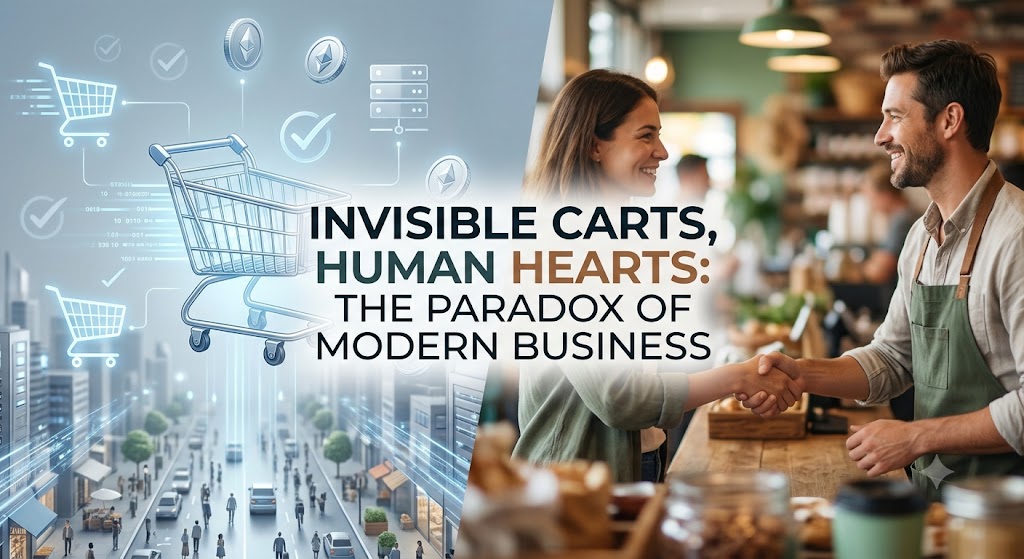
If you’ve bought anything online recently, you’ve probably noticed that the checkout line is quietly vanishing.
We are living through a massive shift in how value changes hands. Payment processing has evolved past plastic cards and manual forms into something completely different: a world driven by invisible transactions and agentic commerce (where AI agents are authorized to buy things on our behalf).
It’s incredibly efficient. But as transactions become entirely automated, an interesting counter-trend is emerging. The more automated and cold-coded our transactions get, the more valuable true, human customer service becomes to our local communities.
The Rise of the “Invisible” Economy
We are rapidly moving away from the era of manual payments. Today, AI isn’t just protecting our cards from fraud; it’s redefining the purchase itself.
- Agentic Commerce: Major payment processors like Visa and J.P. Morgan are actively rolling out “agentic ready” frameworks. Instead of manually searching, comparing, and filling out shipping data, users can authorize a secure AI agent to buy things for them. The agent uses secure tokenization to complete the transaction without the user ever opening a browser.
- Real-Time Adaptive Risk Scoring: AI has entirely replaced rigid, legacy fraud rules. Instead of freezing your card just because you’re traveling, modern systems score transactions instantly based on deep contextual signals—like typing rhythms, device behavior, and real-time data networks. This cuts false declines while blocking complex cyber threats in milliseconds.
- Log In and Pay: Digital identity wallets are merging authentication and payment into a single step. Biometric passkeys let you verify your identity and authorize a transfer simultaneously, making guest checkouts entirely frictionless.
The Great Disconnect
This hyper-efficiency is a dream for productivity, but it introduces a subtle risk: the loss of human touch.
When transactions are completely seamless, we lose the casual interactions that historically bound communities together. Marketplace exchanges risk turning into a cold series of automated pings between your AI agent and a faceless corporate server.
When a machine handles the discovery, the payment, and the logistics, what happens when something goes wrong? What happens when a consumer faces a confusing financial emergency, or a small business owner encounters a unique, unpredictable glitch?
Why Great Customer Service is the Ultimate Neighborhood Anchor
This is precisely where real customer service steps into its own. As AI automates repetitive backend tasks, human support is transitioning from a transactional cost center into a core pillar of community trust.
AI processes the DATA (Frictionless, Secure, Scalable)
   │
   └───► Humans provide the CONTEXT (Empathy, Grace, Local Connection)
1. Genuine Empathy Trumps Simulated Politeness
When a customer is dealing with an identity theft scare or a complex billing dispute that threatens their weekly payroll, a polite chatbot won’t cut it. They need a human peer who can truly listen, validate their stress, and take genuine accountability to fix the problem.
2. Navigating Life’s Edge Cases
Clean code assumes a clean world, but human lives are messy. An AI agent cannot grant an extension on a late fee because it knows a family is dealing with a sudden medical crisis. Local businesses operate with a currency AI completely lacks: discretion and grace.
3. Creating a Sense of Belonging
In an era dominated by global e-commerce algorithms, exceptional, personal support is the ultimate competitive advantage for small businesses. A business that remembers your name, values your relationship, and handles issues with a handshake builds long-term loyalty that an automated portal simply cannot match.
Balancing the Digital and the Personal
The goal of modern innovation shouldn’t be to build an automated world completely devoid of human contact. The goal is a balanced hybrid model.
Let the algorithms handle the heavy lifting—securing accounts, optimizing routing, and taking the friction out of checkout lines. But let businesses use those time savings to invest back into their teams. By empowering staff to focus on deep, empathetic, and meaningful support, we can ensure that as our commerce becomes faster and more digital, our communities remain fundamentally human.
Alan J. Mackinder