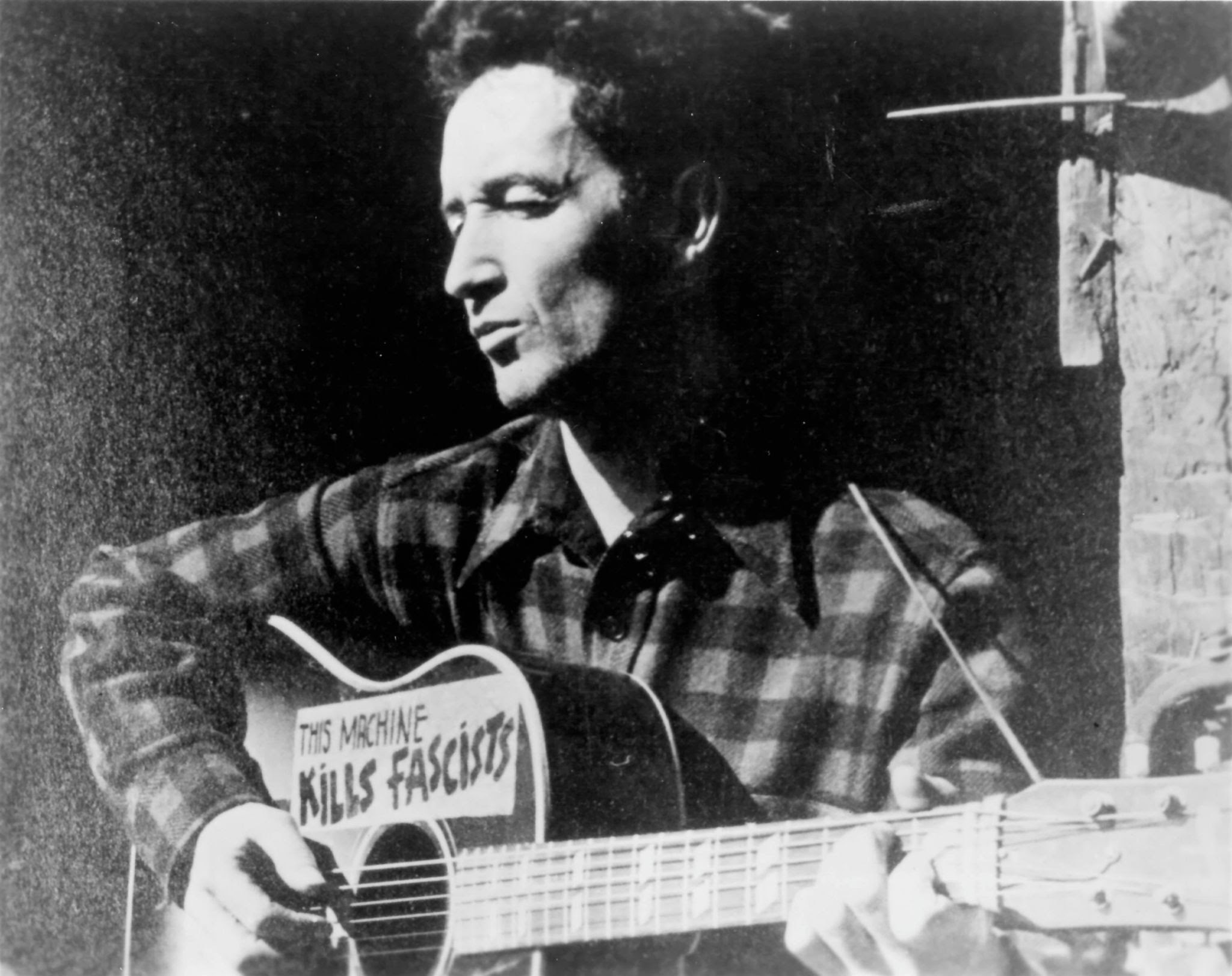
If you’ve ever sung along to “This Land Is Your Land” in elementary school, you were probably taught that it’s a sweet, cozy campfire song about amber waves of grain.
But you were only getting half the story.
The man who wrote it, Woodrow Wilson Guthrie, wasn’t interested in writing comforting jingles. He was a restless, radical, guitar-wielding poet who spent his life hitchhiking across a broken America, hitching rides on freight trains, and documenting the raw grit of the working class. Long before Bob Dylan picked up an acoustic guitar or Bruce Springsteen sang about the margins of the American Dream, Woody Guthrie built the literal blueprint for music as an act of rebellion.
The Ultimate Anti-Pop Star
During his commercial peak in the 1940s, Woody Guthrie had all the pieces of a multi-media star. He was a major-label recording artist for RCA Victor, a published author with his autobiography Bound for Glory, and a regular voice on national CBS radio networks.
But Woody absolutely loathed the conformity that came with success.
Every time a lucrative contract or a stable radio gig threatened to domesticate him, he walked. He famously abandoned high-paying radio shows in New York and Los Angeles simply because he couldn’t stand being told what to do or where to stay. He was a chronic wanderer, driven by a deep-seated individualism and a radical leftist worldview. When he wrote columns, he didn’t write them for mainstream papers—he wrote them for the People’s World and the Daily Worker, two communist publications.
For Woody, music wasn’t a career path. It was a frontline report from the trenches of human suffering.
Turning Melodies Into Left-Wing Rebuttals
Woody’s songwriting genius lay in an old folk tradition: parody songwriting—taking existing traditional melodies and rewriting them with razor-sharp, localized political lyrics.
Consider his most famous track, “This Land Is Your Land.” In 1940, as World War II loomed, Irving Berlin’s “God Bless America” was blasted on every jukebox in the country. Woody found the song blindly jingoistic and smugly blind to the harsh realities of the Great Depression.
In response, he penned an “answer song” originally titled “God Blessed America for Me.” It used a simple melody borrowed from a Baptist gospel group, but the words were a direct assault on private property and the capitalist system. He sang about standing in the shadow of a steeple by the relief office, looking at a “Private Property” sign, and boldly declaring that the sign didn’t say nothing on the back side—meaning that side belonged to you and me.
Over the decades, history sanitized the song into a textbook anthem, but its bones remain entirely radical.
A Legacy Written in the Hospital Wards
The great, heartbreaking irony of Woody Guthrie’s life is that his greatest impact on American culture happened when he was entirely locked away from it.
By the late 1940s, Woody began exhibiting erratic physical and mental behaviors. Friends and family initially wrote it off as severe alcoholism. In reality, Woody had inherited Huntington’s disease—the same rare, degenerative genetic condition that had claimed his mother years prior.
By 1954, unable to control his muscles or play his guitar, he voluntarily checked himself into Brooklyn State Hospital. He spent the next thirteen years permanently institutionalized, slowly slipping away.
But while Woody was confined to a hospital bed, his songs took flight:
- The 1950s Folk Revival: Groups like The Weavers and The Kingston Trio brought his Dust Bowl ballads to the top of the pop charts.
- The Arrival of Bob Dylan: In 1961, a nineteen-year-old Dylan hitchhiked to New York with one primary mission: to visit his idol, Woody Guthrie, in his hospital room. Dylan basically adopted Woody’s voice, his phrasing, and his worldview, passing the torch to a new generation.
- The Lost Lyrics: Decades after his death in 1967, Woody’s estate invited alternative rock mainstays Billy Bragg and Wilco to look through thousands of unpublished lyrics Woody had written but never set to music. The resulting Mermaid Avenue albums proved that Woody’s voice was just as vital and sharp at the turn of the 21st century as it was in 1940.
Why Woody Still Matters
Woody Guthrie lived through devastating personal fires, family madness, the dust storms of the Great Depression, and the horrors of World War II. He didn’t look at the world through rose-colored glasses, but he never gave up on the people living in it.
He left behind a body of work that serves as a permanent reminder: music doesn’t just have to entertain us. At its best, it can hold up a mirror to our injustices, comfort the dispossessed, and remind us exactly who this land belongs to.
Woody Guthrie: Music as a weapon for the working class.. Source: Michael Ochs Archives / Getty Images





Leave a Reply
You must be logged in to post a comment.