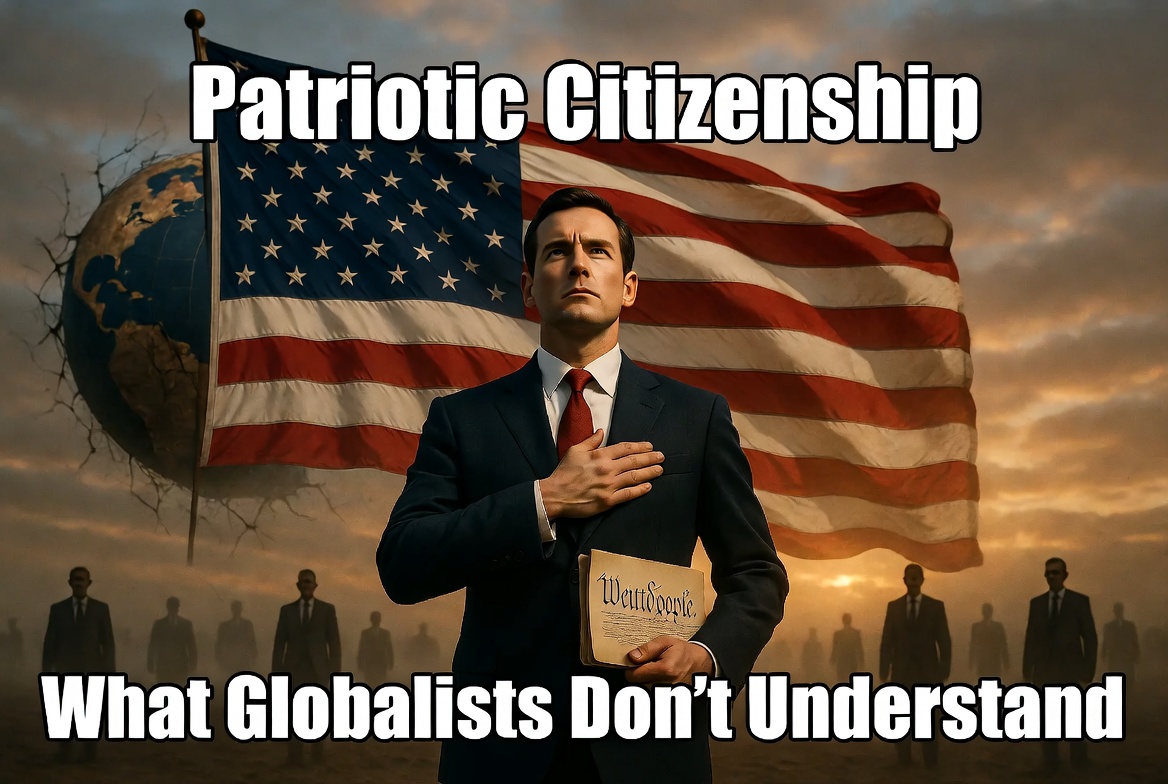
In an age where borders are called “constructs,” flags are dismissed as “divisive,” and loyalty to your own country is sneered at as “backward,” it’s time to push back. Patriotic citizenship isn’t some dusty relic from the 19th century. It’s the practical, proven engine that turns a collection of individuals into a functioning, prosperous society. And the people pushing a borderless, one-world vision—let’s call them globalists—fundamentally misunderstand human nature, history, and basic incentives. They think erasing nations will bring utopia. History (and common sense) says otherwise.
What Patriotic Citizenship Actually Means
Patriotic citizenship is simple: you love your country enough to defend it, improve it, and pass it on better than you found it. It’s not blind jingoism or hating foreigners. It’s the active choice to prioritize the well-being of the people who share your laws, language, culture, and history.
- Loyalty with accountability: You obey the laws because they’re yours—made by your representatives, enforced by your neighbors. You pay taxes not out of guilt, but because they fund the roads, schools, and military that protect the society you value.
- Civic duty: Voting, jury service, volunteering, raising kids who understand the Constitution or equivalent founding documents. It’s showing up for the place that gives you freedom and opportunity.
- Cultural stewardship: Preserving the stories, traditions, and values that make your nation distinct. Not because they’re “superior” to everyone else’s, but because they’re yours. They create the social trust that lets strangers cooperate without constant suspicion.
- Defense when needed: When threats arise—foreign or domestic—you don’t outsource your security to the UN or some Davos panel. You stand ready because this land is your home.
Countries built on this model—think post-WWII America, Japan’s recovery, Israel’s resilience—have delivered unprecedented prosperity, innovation, and individual rights. Nations that lose this spirit? They fracture.
The Globalist Dream (and Its Blind Spots)
Globalists envision a world where national sovereignty is quaint, borders are “racist,” and problems are solved by supranational bodies, NGOs, and multinational corporations. Trade without friction, migration without limits, culture without roots. It sounds compassionate on paper: end wars, end poverty, celebrate “diversity.”
But here’s what they consistently miss—every single time:
- Humans are not interchangeable widgets. We’re wired for belonging. Evolutionary biology, anthropology, and every successful civilization show it: people form tribes, then nations. Shared language, customs, and memory create the high-trust environment where contracts are honored, crime is low, and kids thrive. Flood a society with rapid, unassimilated change and trust erodes. Crime stats, welfare costs, and polling data from Europe and U.S. border states aren’t “phobias”—they’re patterns. Globalists treat culture like a buffet you can mix endlessly without indigestion. Reality says otherwise.
- Sovereignty isn’t oppression—it’s self-defense. A nation-state is the only entity that can legitimately use force to protect its citizens’ rights. The EU, UN, or World Economic Forum can’t draft an army or enforce a constitution. They issue edicts; they don’t bear the consequences when those edicts fail. Globalists want power without responsibility. Patriotic citizens understand that the ballot box, the jury box, and (if necessary) the cartridge box only work inside a defined polity.
- Economics isn’t magic—it has borders. Free trade is great when partners play fair and you retain strategic industries. But when globalist policies ship manufacturing overseas, hollow out the middle class, and then lecture the unemployed about “retraining for the knowledge economy,” people notice. Cheap goods at Walmart don’t pay the mortgage or fund pensions. Nations that protect their workers’ bargaining power (through tariffs, immigration control, or industrial policy) keep wealth circulating at home. Globalists act shocked when voters reject this—see Brexit, Trump 2016/2024, Europe’s populist surge.
- Democracy dies at the global level. Real self-government requires voters who share enough in common to debate and compromise. Scale it to the entire planet and you get rule by distant elites who never face the voters they harm. The people pushing climate accords, digital IDs, or open borders rarely live in the neighborhoods transformed by those policies. Patriotic citizenship keeps power close to home—where accountability actually works.
- History keeps score. The 20th century’s experiments in supranationalism (League of Nations, Soviet internationalism, even the early EU’s overreach) show the pattern: elites centralize, ordinary people lose agency, and resentment builds. Meanwhile, nation-states—flawed as they are—lifted billions from poverty through competition, not central planning. Globalists rewrite this as “colonialism bad, global governance good” while ignoring that the strongest pushers of globalism today are the same Davos crowd whose policies create the very inequality they decry.
Why This Matters Now
Patriotic citizenship doesn’t require uniforms or parades (though those are fine). It requires rejecting the lie that your country is just a random ZIP code on a dying planet. It means teaching kids that gratitude for what previous generations built is not hate—it’s sanity.
Globalists don’t understand this because their worldview is abstract. They live in airports, Zoom calls, and think-tanks. They’ve never watched their hometown change beyond recognition or sent their kid to a school where the teacher can’t pronounce half the names. They mistake elite consensus for universal truth.
The rest of us don’t have that luxury. We live here. We raise families here. We defend the imperfect but improvable experiment called our country.
So the next time someone calls patriotism “nationalism” and sneers, ask them: If nations are so obsolete, why do globalist billionaires still keep their money, their private jets, and their security teams inside the very borders they want to dissolve?
Patriotic citizenship isn’t the problem. It’s the solution globalists can’t afford to admit exists.
What do you think—has your country earned your loyalty, or should we all just dissolve into one big happy global village? Drop your thoughts below.
Alan J. Mackinder is Senior Strategist at Mackinder Strategies. A U.S. Marine with deep expertise in geopolitical analysis and digital strategy, he helps leaders navigate uncertainty with data, history, and foresight.