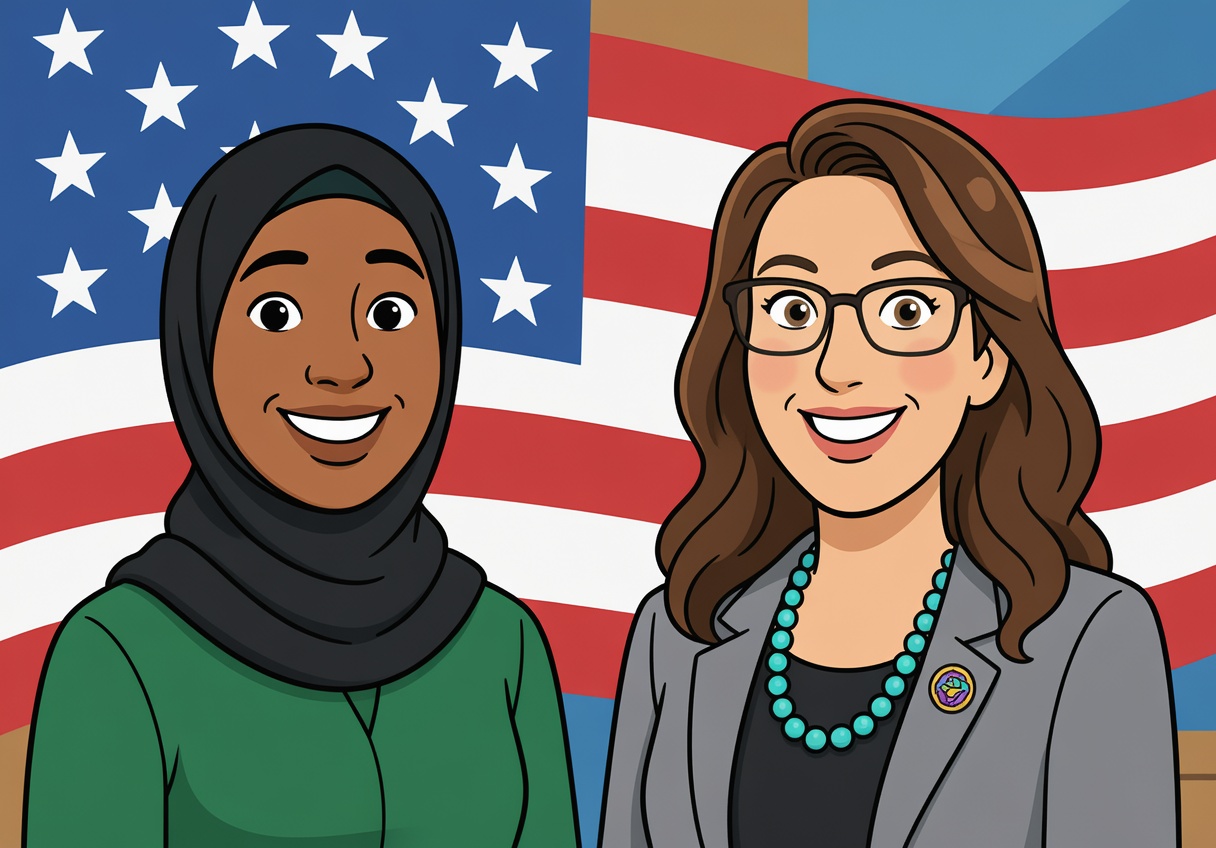
In an era of intense U.S. political division, few lawmakers more clearly represent the ideological outer edges than Rep. Lauren Boebert (R-CO-4) and Rep. Ilhan Omar (D-MN-5). Boebert, a leading voice in the House Freedom Caucus and a staunch MAGA-aligned conservative, anchors the far-right populist wing of the Republican Party. Omar, a core member of “The Squad” and deputy chair of the Congressional Progressive Caucus, anchors the far-left progressive wing of the Democratic Party.
Their occasional public clashes underscore not just personal friction but the broader chasm dividing American politics. For MackinderStrategies.com—focused on geopolitics, grand strategy, and the long-term dynamics of power—this matters because domestic polarization directly erodes the bipartisan consensus needed for coherent U.S. foreign policy in a multipolar world of great-power competition.
On the classic left-right spectrum (economics, social/cultural issues, immigration, and foreign policy), Boebert sits firmly on the far right; Omar on the far left. Their records, as tracked by sources like GovTrack and historical DW-NOMINATE scores, consistently place them among the most ideologically extreme members of their respective parties.
Economic Policy: Free-Market Absolutism vs. Democratic Socialism
- Boebert (Far-Right Conservative): Champions limited government, tax cuts, deregulation, and energy dominance through domestic fossil fuels. She has repeatedly opposed the Green New Deal, Medicare for All, and large-scale federal spending, arguing these undermine individual liberty, economic growth, and American competitiveness.
- Omar (Far-Left Progressive): Pushes for government-led redistribution, universal programs, and structural reforms to capitalism. She co-sponsors Medicare for All, Green New Deal legislation, student debt cancellation, and higher taxes on corporations and the wealthy to fund social safety nets and address inequality.
Spectrum Placement: Boebert represents right-libertarian economics with a nationalist protectionist edge; Omar embodies left-collectivist economics centered on equity and state intervention.
Social/Cultural Issues: Traditional Values vs. Social Justice Transformation
- Boebert: Vocal defender of Second Amendment rights, pro-life positions, and parental authority in education. She opposes “woke” policies—such as critical race theory, certain gender ideologies in schools, or transgender participation in youth sports—framing them as threats to traditional family structures, religious liberty, and cultural heritage.
- Omar: Advocate for expansive LGBTQ+ rights, racial equity initiatives, criminal justice reform, and unrestricted abortion access. She supports DEI programs and views cultural and institutional overhaul as essential to dismantling systemic inequities.
Spectrum Placement: Boebert anchors social conservatism and cultural traditionalism; Omar anchors progressive liberalism and identity-focused equity politics.
Immigration and Border Security: National Sovereignty vs. Humanitarian Inclusion
- Boebert: Advocates strict enforcement—border walls/technology, ending catch-and-release, mass deportations of undocumented immigrants, and ending sanctuary policies. Emphasis: rule of law, national security, and protecting American workers.
- Omar: Supports comprehensive reform with pathways to citizenship, DACA protections, and asylum expansions. She has criticized aggressive ICE tactics and prioritizes family unity and humanitarian considerations.
Spectrum Placement: Far-right restrictionism and sovereignty-first versus far-left openness and reform-oriented inclusion.
Foreign Policy & Geopolitics: America First Realism vs. Progressive Restraint
This axis carries the highest stakes for Mackinder-style grand strategy analysis.
- Boebert (Nationalist/Realist): “America First” orientation emphasizing military strength, energy independence, and selective engagement against adversaries (China, Russia, Iran). Strong support for key allies like Israel; skepticism of endless wars, nation-building, or international institutions (UN, WHO) that constrain U.S. sovereignty. Foreign aid must deliver clear reciprocity.
- Omar (Progressive Internationalist): Focuses on diplomacy, reduced military budgets, ending “endless wars,” and multilateral cooperation on climate and human rights. Highly critical of unconditional U.S. support for Israel (with past emphasis on Palestinian rights); prioritizes de-escalation, international law, and addressing global inequities over unilateral power projection.
Spectrum Placement: Boebert’s selective, interest-driven realism versus Omar’s idealism and restraint-oriented globalism. In a Mackinderian framework, these poles complicate consistent U.S. strategy: one risks isolationist whiplash, the other idealistic under-commitment—both hindering effective management of the Eurasian Heartland and great-power rivalries.
Strategic Implications for U.S. Grand Strategy
Boebert and Omar exemplify today’s polarization: far-right conservative populism versus far-left democratic progressivism. While debate is healthy, the current extremes fuel gridlock, policy inconsistency, and weakened national will. For strategists tracking demographics, economics, and power projection, this domestic fracture is a critical vulnerability. It makes sustained investment in military posture, alliances, or economic competitiveness harder to maintain amid shifting congressional majorities.
In a multipolar era—where control of key geographic pivots and technological edges will define the 21st century—America’s ability to act decisively depends on bridging (or at least navigating) these divides. Business leaders and geopolitical analysts must factor this reality into long-term risk assessments.
Analysis based on public voting records, official statements, and ideological metrics as of April 2026. Positions can evolve; this is a snapshot of consistent patterns.
What are your thoughts on these poles shaping America’s future strategy? Share in the comments or contact us for deeper analysis. Follow Mackinder Strategies for more on geopolitics, demographics, and power in the modern world.