We all know the narrative: smoking is bad for your health. The medical data is clear, and the economic toll is undeniable—with cigarette smoking costing the United States an estimated $600 billion in 2018 alone, including $240 billion in healthcare spending and hundreds of billions in lost productivity.
But as an economic and geopolitical strategist, I am compelled to look past the surface-level warnings on a carton of cigarettes and examine the underlying fiscal structures. When you analyze the numbers, a stark reality emerges. Yes, smoking is bad. But the way our state and federal governments levy, collect, and misallocate tobacco taxes is an even greater systemic failure.
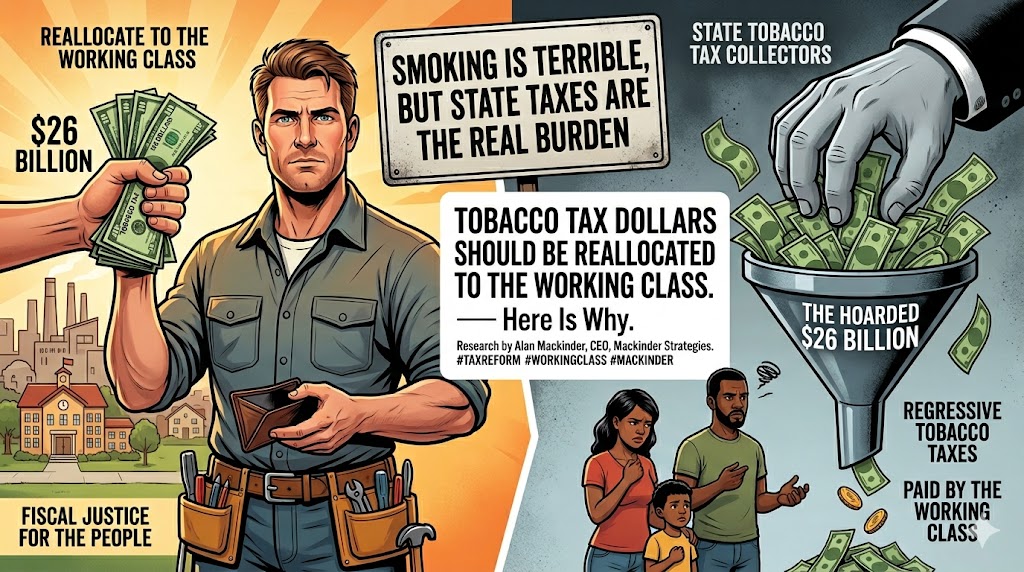
It is time to reform a broken framework. Tobacco tax revenues are fundamentally regressive, punishing the working class under the guise of public health, while state governments hoard the profits. These billions of dollars should be immediately reallocated back to the working class. Here is why.
1. Tobacco Taxes Are a Disproportionate Burden on the Working Class
Proponents of high tobacco taxes argue that raising prices curbs demand. Economically, this is true on paper: a 10% increase in the average price of a pack of cigarettes is estimated to reduce sales per person by about 7%.
But look at who actually bears this burden. The average state tobacco tax sits at $1.93 per pack (ranging from $5.35 in New York to 17 cents in Missouri), on top of a $1.01 federal tax. Tobacco use is statistically higher among lower-income and working-class demographics. Therefore, these flat, per-pack taxes operate as a highly regressive financial penalty. They do not scale with income; they simply drain disposable income from the households that can least afford it.
2. The Government is Hoarding Funds Meant for Public Health
If governments were aggressively using this revenue to fix the problem, a counter-argument could be made. But the data shows that states are using tobacco taxes as a general-fund cash cow while ignoring public health.
In 2024, states will collect a staggering $26 billion from tobacco taxes and the 1998 Master Settlement Agreement, plus an additional $1.1 billion from recent Juul settlements. The CDC recommends that states collectively spend a modest $3.3 billion of that massive windfall on tobacco prevention and cessation programs.
What is the reality?
- Maine is the only state in the entire country funding its prevention program at the CDC-recommended level.
- 31 states and Washington D.C. spend less than 25% of what the CDC recommends.
- 19 states spend less than 10%.
- 10 states spend less than 5%.
States receive billions to help people quit, yet they only reinvest a tiny fraction of it. The rest is absorbed into state budgets, effectively funding government operations on the backs of lower-income smokers.
3. A David vs. Goliath Paradigm
Because states refuse to properly fund prevention, they leave the working class defenseless against massive corporate marketing. Tobacco and nicotine manufacturers spend roughly $8.6 billion a year on advertising and promotion in the U.S. alone—amounting to nearly $1 million spent every single hour.
Worse yet, $5.7 billion (nearly 72%) of that budget goes directly toward retail price discounts. The tobacco industry uses its financial might to artificially lower the consumer cost of cigarettes to keep their product accessible, effectively offsetting the impact of the taxes. For every $1 states actually invest to reduce tobacco use, tobacco companies spend about $12 promoting it. The consumer is caught in a financial tug-of-war between corporate giants and greedy state tax collectors.
4. Shifting Markets, Hidden Costs
As the traditional cigarette market declines—with pack sales dropping 27% between 2015 and 2021—the economic pressure hasn’t vanished; it has just shifted. The nicotine industry has adapted rapidly.
Between 2017 and 2022, monthly U.S. e-cigarette sales skyrocketed from $75 million to $469 million, driven heavily by highly addictive disposable products and high-strength nicotine cartridges (with products containing over 5% nicotine strength surging to capture up to 80-94% of their respective markets). Sales of nicotine pouches and lozenges also doubled to over $1 billion by 2022.
The working class is transitioning to new products, and governments are preparing to tax these products just as aggressively, continuing the cycle of penalizing the same demographic. Meanwhile, the domestic agricultural backbone is shrinking: the number of U.S. tobacco farms collapsed from over 93,530 in 1997 to just about 3,000 in 2022, devastating rural farming communities in states like North Carolina and Kentucky.
The Solution: Reallocate Tax Dollars to the Working Class
The current system is hypocritical. The government claims to tax tobacco to discourage smoking, yet it relies on tobacco revenue to balance its books, all while failing to fund the very cessation programs that would help people quit.
At Mackinder Strategies, we look at economic systems through the lens of fairness and productivity. The current tobacco tax structure is an unjust transfer of wealth from the pockets of working-class citizens into state government coffers.
If the government refuses to spend this money on its intended purpose—tobacco prevention and healthcare—then it has no right to hold it. These tax dollars should be directly reallocated to the working class through:
- Direct working-class tax credits to offset the regressive nature of excise taxes.
- Targeted healthcare subsidies for low-income families to combat the $240 billion in annual medical costs associated with smoking.
- Economic development grants for the rural communities and displaced workers affected by the collapse of domestic tobacco farming.
Smoking is a public health crisis, but the weaponization of regressive taxation is an economic crisis. It is time to stop punishing the working class and start returning their hard-earned dollars.
📢 Break the Cycle: Take Control of Your Health and Wealth
Tired of giving your hard-earned money to greedy state tax collectors and massive corporate tobacco monopolies? The ultimate economic rebellion is taking back your health and your capital.
If you or a loved one are ready to quit smoking without the standard gimmicks, check out Quick Smoking, a strategic blueprint designed to help you break free from nicotine addiction for good. Stop letting regressive taxes drain your bank account.
👉 Grab your copy of Quick Smoking today at Mackinder Strategies!
By: Alan Mackinder Founder of Mackinder Strategies – Geopolitical and Economic Strategist from Cincinnati.